
Best No KYC Betting Sites for US Players for 2026 – No SSN Sportsbooks Accepting New Players
Looking for the best no KYC betting sites and no SSN sportsbooks for US players in 2026? You want a fast sign-up, quick payouts and as little paperwork as possible. This page shows the top sports betting sites with the fastest verification, which documents they ask for and how to get from sign-up to your first bet in minutes.
We also cover the best crypto betting options, banking, bet types, bonuses and the sports you can bet on, so you can pick the right betting site and start betting quickly.
Sports Betting Sites Without ID Verification

Betpanda.io |
100% up to 1 BTC + 10% Weekly Cashback |
100% up to 1 BTC + 10% Weekly Cashback
|
 Betpanda.io Betpanda.io
|
PLAY NOW | The weekly wager-free cashback is distributed on Wednesdays in your main crypto currency. The cashback can be withdrawn without any limitations or used in the casino. |

CoinPoker Casino |
150% up to $2,000 |
150% up to $2,000
|
CoinPoker Casino
|
PLAY NOW | $10 minimum deposit. Bonus is released in installments of 10% when minimum rake requirements are met (twice the bonus amount in rake). For new players and first deposits only. |

Cryptorino |
100% Match Bonus Up To 1 BTC + 10% Weekly Cashback |
100% Match Bonus Up To 1 BTC + 10% Weekly Cashback
|
Cryptorino
|
PLAY NOW | The Bounty Welcome Bonus offers 100% of your first deposit up to a maximum of 1 BTC or the equivalent amount in supported cryptocurrencies. The bonus will only be credited after the player meets the wagering requirements. The deposit must be wagered 66 times. Players have 7 days from first deposit to meet the wagering requirement. |

BC Game |
Four Match Bonuses Up To $4,000 + 400 Free Spins |
Four Match Bonuses Up To $4,000 + 400 Free Spins
|
BC Game
|
PLAY NOW | Welcome bundle on the four first deposits. Min deposit of $5.00 is required for the first two bonuses and a minimum deposit of $15.00 is required for the last two bonuses. The bonus and deposit must be wagered 20 times (20x) and Free Spins must be wagered 40 times (40x). |

Winna |
Up to 60% Rakeback & 25% Instant Cashback |
Up to 60% Rakeback & 25% Instant Cashback
|
Winna
|
PLAY NOW | New players only. Terms and conditions apply. |

Thrill |
Up to 70% Rakeback + 10% Cashback |
Up to 70% Rakeback + 10% Cashback
|
Thrill
|
PLAY NOW | 18+. All terms and conditions apply. Make sure to read original document on the site for full disclosure. |

Hyper Lucky |
20% Daily Cashback up to $10,000 + 100 FS |
20% Daily Cashback up to $10,000 + 100 FS
|
Hyper Lucky
|
PLAY NOW | 18+. All terms and conditions apply. Make sure to read original document on the site for full disclosure. |

Cybet |
100% Match up to $1,000 + 50 Free Spins |
100% Match up to $1,000 + 50 Free Spins
|
Cybet
|
PLAY NOW | 18+. All terms and conditions apply. Make sure to read original document on the site for full disclosure. |

Wild.io |
Up to 350% Welcome Package on Your First 3 Deposits + 200 Free Spins |
Up to 350% Welcome Package on Your First 3 Deposits + 200 Free Spins
|
Wild.io
|
PLAY NOW | Minimum $20 to get the bonus. The maximum bonus amount is 1,000 USD, or its equivalent in the other currencies available. The wagering requirement is 40x. |

Vave |
Up To 4 BTC + 100 FS + 5% Cashback |
Up To 4 BTC + 100 FS + 5% Cashback
|
Vave
|
PLAY NOW | The bonus will be given in installments depending on the wager done. All information about the wager is available by clicking on the “info” tab in the bonus card. Bonus should be wagered within 30 days. The qualifying deposit must be made as a single transaction in amount of 20 USDT(or equivalent in another cryptocurrency) or more. |
Read our page to learn:
🥷 Why sports betting sites without ID verification are not licensed in any US state
⚡ How fast identity checks are at licensed sportsbooks, and how to pass them first time
💰 Why bonuses at licensed books are only paid after verification
🔐 What licensed sportsbooks do with your SSN and documents, and why they ask
🏈 What types of bets and sports markets are available at state-licensed sportsbooks
✅ Where crypto is accepted by regulated or permitted products, and why a VPN is not the answer
Let’s look at what no-KYC betting means for US players in 2026: the law, the verification process, the payment options and how to bet safely with a book that answers to a state regulator.
Best No KYC Betting Sites – Closer Look at Top-Rated Options
Curious which no-KYC sportsbooks are worth your time? In the US, every licensed sportsbook must verify your identity and age before you bet, so a sportsbook that takes bets without those checks is not operating under a US state licence. The good news is that verification at licensed books is usually quick. Below, we take a closer look at the three questions behind this search: why verification exists, how to get through it fastest, and where crypto fits in. Further down we cover the legal position for US players, banking, bet types, bonuses and why a VPN does not help.
1. No KYC Betting in the US: Why Sportsbooks Verify Your ID
KYC stands for “know your customer”. At a licensed US sportsbook it is not optional: state rules require the operator to confirm who you are and how old you are before you can place a wager. Kentucky’s sports wagering regulation, 809 KAR 10:004, is a typical example. It requires the account holder’s full legal name, date of birth and Social Security number (or its last four digits, or an equivalent government number for a noncitizen), and it requires the licensee to verify those details before wagers are placed.
There are three reasons for the rule. The first is age: sportsbooks must keep minors out, and the minimum age is 21 in most states. The second is fraud and money laundering: verified accounts make it much harder to bet with stolen identities or to move illicit funds through betting accounts. The third is player protection: self-exclusion lists, deposit limits and tax reporting all depend on knowing who the account belongs to.
The same logic applies to other regulated products. Prediction markets regulated by the Commodity Futures Trading Commission verify their customers too, and even sweepstakes platforms, which are not gambling licensees, ask for identity documents before paying out prizes.
| Who requires it | State sports wagering laws and regulations (e.g. Kentucky, 809 KAR 10:004) |
|---|---|
| Information usually requested | Full legal name, date of birth, residential address, SSN or its last four digits |
| When it happens | Before your first wager; some books also check again before a withdrawal |
| Minimum age | 21 in most states; check your state regulator |
| Why it exists | Age checks, fraud and money-laundering prevention, self-exclusion, tax reporting |
| Sportsbooks that skip it | Not licensed in any US state |
| Last checked | October 2026 |
🥇 Why It Matters
- ✅ Your account is protected: a verified account is harder for someone else to open or take over in your name.
- ✅ You can get paid: withdrawals go to payment methods in your own name once your identity is confirmed.
- ✅ You have a regulator: licensed sportsbooks answer to the state if something goes wrong.
- ✅ Self-exclusion works: state and operator self-exclusion depends on knowing who you are.
- ✅ Minors are kept out: age checks are the main barrier to underage betting.
- ✅ Tax records are accurate: gambling winnings are taxable, and a verified account keeps a clear record.
🚀 What to Watch
- ⚠️ Mismatched details: a typo in your name, address or date of birth is the most common reason automatic checks fail.
- ⚠️ PO boxes: operators generally need a residential address, not a PO box or business address.
- ⚠️ Expired ID: document uploads are rejected if the ID is expired or unreadable.
- ⚠️ Someone else’s card: payment methods must be in your own name.
- ⚠️ Phishing: only upload documents inside the sportsbook’s own app or site, never by email to someone who contacts you.
2. No ID Upload Needed? How Fast Verification Works at US Sportsbooks
Most people searching for no-KYC betting simply want to start quickly. The good news is that verification at licensed sportsbooks is usually fast. When you register, the sportsbook checks your name, date of birth, address and SSN digits against identity databases. If everything matches, you are typically verified during sign-up, with no document upload needed.
If the automatic check cannot confirm your details, the sportsbook asks for a document, usually a driver’s license or passport, and sometimes a selfie so the photo can be matched to your face. Kentucky’s rule lists the methods operators can use, including knowledge-based questions, a phone or email match, or a valid government-issued ID. A manual review takes longer than the automatic check, and each sportsbook states its current timing on its own help pages.
Regulated prediction markets work the same way. Kalshi’s help center, for example, says it accepts a valid driver’s license or a valid passport, may ask for a live selfie, and that verification usually takes just a few minutes when your photo is clear. It also says that details on your ID must match your profile exactly and that addresses linked to PO boxes or businesses cannot be accepted.
| Step 1 | Enter your legal name, date of birth, residential address and SSN digits exactly as they appear on your records |
|---|---|
| Step 2 | Automatic database check, usually completed during sign-up |
| Step 3 (only if needed) | Upload a valid driver’s license or passport; some operators also ask for a selfie |
| Step 4 (only if needed) | Proof of address or source of funds for larger accounts or withdrawals |
| Documents not accepted | Expired IDs, photocopies, screenshots and non-government IDs (per Kalshi’s help center) |
| How long it takes | Automatic checks: during sign-up. Document reviews: longer, see the operator’s help pages |
| Last checked | October 2026 |
🥈 How to Verify Faster
- ✅ Use your legal name: the exact name on your ID, not a nickname.
- ✅ Use your current home address: the one on your ID or your bank records.
- ✅ Have your ID ready: a valid driver’s license or passport, in good light, with all four corners visible.
- ✅ Verify before you deposit: complete every step at sign-up so your first withdrawal is not held up.
- ✅ Switch off your VPN: location and identity checks run together, and a VPN can make them fail.
- ✅ Use payment methods in your name: this avoids extra ownership checks later.
🚀 What Slows It Down
- ⚠️ Recent moves: a new address that is not yet on your records may trigger a document request.
- ⚠️ Busy periods: manual reviews can take longer around big events.
- ⚠️ Blurry photos: unreadable images are the most common reason uploads are rejected.
- ⚠️ Location problems: you must be physically in a state where the sportsbook is licensed.
- ⚠️ Duplicate accounts: one account per person; a second account will be flagged.
3. No KYC Crypto Betting: Where Crypto Is Accepted in the US
Crypto and no-KYC betting are often sold together. For US players, crypto is acceptable only where a regulated or permitted product really accepts it, and every one of those products still verifies your identity.
The clearest example is a prediction market regulated by the CFTC. The CFTC designated KalshiEX LLC as a contract market on November 4, 2020, and Kalshi’s help center documents crypto deposits: transfers are processed through Zero Hash, which converts crypto to and from fiat, and typically take up to 30 minutes, subject to network and provider fees. Identity verification applies as for any other Kalshi account. Note that some states dispute sports event contracts: in December 2025, Connecticut’s Department of Consumer Protection ordered Kalshi, Robinhood and Crypto.com to stop offering them in the state, and the dispute is now before the courts, so check the position where you live.
Sweepstakes platforms are another permitted product in some states. Some of them allow Gold Coin purchases in fiat or a supported cryptocurrency under their sweepstakes terms. Terms vary by platform, but they set a minimum age, request ID and proof of address before prizes are redeemed, and publish a list of excluded states. Sweepstakes casinos are banned or restricted in several states, including California, New York, New Jersey, Connecticut, Montana, Indiana, Maine, Tennessee, Oklahoma and Louisiana. Always check crypto acceptance on the product’s own help or banking page.
| CFTC-regulated prediction market | Federal oversight; crypto deposits where the exchange documents them (e.g. Kalshi via Zero Hash); ID verification required |
|---|---|
| Sweepstakes platform | Not a gambling licence; crypto purchases where the platform’s terms allow it; ID required; excluded states apply |
| State-licensed sportsbook | Payment methods approved under the state licence; check the cashier rather than assuming crypto is accepted |
| Offshore crypto sportsbook | Not licensed in any US state; no state player protections apply |
| How to check a prediction market | Search the firm on the CFTC’s registration check |
| State disputes | Some states contest sports event contracts (e.g. Connecticut, December 2025) |
| Last checked | October 2026 |
🥉 Why It Matters
- ✅ Federal oversight: CFTC-designated exchanges must meet ongoing compliance requirements.
- ✅ Documented crypto rails: deposits go through a named provider and are converted to dollars.
- ✅ Verified accounts: identity checks protect your balance from takeover.
- ✅ Clear terms: sweepstakes rules and exclusions are published in full.
- ✅ A route to complain: regulated firms answer to a regulator.
🚀 What to Watch
- ⚠️ State disputes: the legal status of sports event contracts is contested in some states.
- ⚠️ Fees: blockchain network fees and conversion costs apply to crypto deposits.
- ⚠️ Wrong network: sending an unsupported coin or using the wrong network can lose the funds.
- ⚠️ Excluded states: sweepstakes products are unavailable in several states.
- ⚠️ Not anonymous: none of these products lets you skip identity checks.
- ⚠️ Not a sportsbook: a prediction market trades event contracts on an exchange; the rules differ from a sportsbook’s house rules.
Best Crypto Betting Sites with No KYC
| Product type | Crypto accepted | Identity checks |
| CFTC-regulated prediction markets | Only where the exchange documents crypto deposits (e.g. Kalshi, converted to USD via Zero Hash) | Required: driver’s license or passport, sometimes a selfie |
| Sweepstakes platforms | Only where the platform’s terms allow it, typically for Gold Coin purchases | Required: ID and proof of address; prizes not redeemed until verified |
| State-licensed sportsbooks | Check the cashier; methods are those approved under the state licence | Required before your first wager |
| Offshore no-KYC crypto sportsbooks | Usually crypto only | Often skipped at sign-up, but can be demanded before a withdrawal; not licensed in any US state |
The point of this table is simple: there is no regulated US product that offers crypto betting without identity checks. If a site offers both crypto and no verification to US players, it is operating outside US licensing.
Best Fiat Betting Sites with No KYC
| Payment method at licensed sportsbooks | What it means for verification | Good to know |
| Debit card | The card must be in your name; the operator may check that it matches your account | Some banks decline gambling transactions; check with your bank |
| Online banking / ACH | Linked to an account in your name, which supports quick identity matching | Often used for withdrawals as well as deposits |
| E-wallets | The e-wallet account itself is verified, and must match your sportsbook account | Availability depends on the operator and state |
| Prepaid cards | Do not remove the identity check on your sportsbook account | Withdrawals usually go to a different method in your name |
All No KYC Sportsbooks – Comparison Table
| Claim made by no-KYC sportsbooks | What it means for a US player | At a state-licensed sportsbook | Source |
| “No ID needed” | The site is not licensed in your state | Identity verified before your first bet | State sports wagering rules (e.g. 809 KAR 10:004) |
| “VPN-friendly” | Hiding your location breaches terms and state location rules | Location confirmed before bets are accepted | State geolocation requirements |
| “Instant crypto payouts” | Crypto transfers are hard to reverse if a site does not pay | Withdrawals to methods in your name | Michigan Gaming Control Board warning |
| “Licensed offshore” | A foreign licence does not authorize bets from US states | Licensed by the state regulator or lottery | State regulator lists |
| “Huge bonuses” | Often with high playthrough and terms you cannot enforce | Terms subject to state rules | Operator terms |
| “No limits” | No enforced responsible gambling tools | Deposit, wager and time limits plus self-exclusion | State licence conditions |
| “Bet from anywhere” | Bets from states without legal sports betting are not authorized | Only in states where the book is licensed | State law |
| “Nobody gets punished” | Regulators issue cease-and-desist orders; players can lose deposits and winnings | Disputes go to the state regulator | MGCB and Connecticut DCP releases |
| “No taxes” | Gambling winnings are taxable income wherever you win | Form W-2G issued above thresholds | IRS Topic 419 |
| “Provably fair” | Self-certified by the site; no state testing | Systems tested under state technical standards | State regulators |
| “Anonymous account” | No way to recover the account or prove ownership | Account tied to your verified identity | Operator terms |
| “Crypto keeps you private” | Public blockchains record every transfer | Payment data protected under the licence | Blockchain design |
What Is a No KYC Betting Site?

A no-KYC betting site is a sportsbook or casino that lets users sign up, deposit and wager without providing personal information: no photo ID, no address check and no age check. Registration usually needs only an email address or a crypto wallet. In the US, no such site holds a state sports wagering licence, because every state that licenses sports betting requires identity and age verification.
KYC stands for Know Your Customer, a set of checks licensed operators must carry out for fraud prevention, anti-money laundering (AML) and age verification. The checks include customer identification, where the bettor provides details that are matched against records or official documents, and address verification under Customer Due Diligence guidelines.
No-KYC betting sites usually operate only in cryptocurrency and are licensed, if at all, in foreign jurisdictions. A foreign licence does not authorize an operator to take bets from players in any US state, and it gives a US player no state regulator to turn to if a withdrawal is refused.
No Verification Betting Sites: What US Players Should Know
Sites that skip verification are not licensed in any US state, so the state protections do not apply to them: there is no state-tested platform, no state-enforced responsible gambling tools and no state regulator to hear a complaint. State regulators publish their position on this. The Michigan Gaming Control Board, for example, has issued releases about unlicensed offshore websites, describing problems such as withheld winnings and unfair wagering requirements.
Skipping KYC at sign-up also does not mean it is never asked for. Many sites keep the right to demand documents before paying a withdrawal, which means you may hand over your data anyway, to a company outside US rules, at the moment it holds your money. The simpler route is to verify once with a state-licensed sportsbook that must protect your data under its licence.
VPN Use and No KYC Betting
Guides to no-KYC betting often tell US players to use a VPN to reach offshore online casinos and sportsbooks. A VPN does not change where you are for betting purposes. Licensed US sportsbooks must confirm that you are physically inside a state where they are licensed before they accept a bet, and a VPN is designed to hide your real location.
- 🇺🇸 Location rules: a bet is placed from where you physically are, not from where your VPN server is. A wager from a state without legal sports betting is not an authorized wager.
- 📄 Operator terms: operators prohibit masking your location. International sportsbooks typically treat VPN use to get around geo-blocking as a breach of their terms, and many list the United States as a restricted jurisdiction.
- 💸 Your money: accounts found using a VPN can be closed, and bonuses or winnings voided under the terms.
Commercial VPN services are privacy tools for everyday browsing, for example on public Wi-Fi. They are not a way to bet from a place where betting is not authorized, and licensed sportsbooks will not accept bets while one hides your location.
VPN Tips: Switch It Off Before You Bet
- Pause your VPN before opening a sportsbook app or site.
- Allow location access when the sportsbook asks, so the geolocation check can confirm where you are.
- Check the state you are in when you travel; the rules follow your physical location.
- Stay inside the state for the whole session. Location checks repeat, and bets are refused once you leave the state.
Betting Sites That Do Not Require SSN or ID: US Rules
No sportsbook licensed in the US works this way. State sports wagering rules require operators to collect and verify your identity before you bet. Kentucky’s regulation, for example, requires your full legal name, date of birth and Social Security number or its last four digits (or an equivalent government identification number for a noncitizen), and the operator must verify them before wagers are placed.
Offshore sportsbooks that skip these checks are not licensed by any US state regulator, such as the New Jersey Division of Gaming Enforcement or the Nevada Gaming Control Board. Federal law also targets their payments: the Unlawful Internet Gambling Enforcement Act bars gambling businesses from accepting payments in connection with unlawful internet gambling.
Bottom line: a sportsbook that does not ask for your SSN or ID is not a licensed US sportsbook. If you want to bet legally, use a sportsbook licensed in your state, aged 21 or over in most states, with your VPN switched off.
What Makes a No KYC Sportsbook Legit?
For a US player, a sportsbook is legitimate when your state has licensed it. These are the markers to check:
- It appears on your state regulator’s or lottery’s list of approved sports wagering operators
- It verifies your identity and age, and the minimum age matches your state’s rule
- It checks your location before accepting bets
- It pays withdrawals to payment methods in your own name
- It publishes full bonus terms, including playthrough and expiry
- It offers deposit, wager and time limits and self-exclusion
- It names the regulator you can complain to
A site that offers no verification fails the first test, whatever other features it promotes. Pennsylvania, for example, publishes its licensed online sports wagering operators, and Connecticut names its three licensed sports wagering platforms.
How We Determine the Best No KYC Betting Sites

Because sites without verification are not licensed in the US, we do not rank them. When we assess sportsbooks for US readers who want the quickest, simplest sign-up, we look at the following:
State Approval
Anonymous betting sites are not licensed by state regulators like the New Jersey Division of Gaming Enforcement or the Colorado Division of Gaming. The first thing we check is whether a sportsbook is on the regulator’s list in the states it serves. A licence from an offshore authority does not count for US players, however clearly it is displayed.
Reputation
A sportsbook’s reputation matters, but for US players it starts with the regulator. State regulators publish enforcement actions and warnings, such as the Michigan Gaming Control Board’s cease-and-desist orders against offshore sites. User reviews on forums can add detail about support and payout experience, but they cannot replace a licence check.
Banking Options
We look at the payment methods a licensed sportsbook offers in its cashier, whether withdrawals go back to methods in your name, and whether the terms explain processing times and fees. Where a regulated or permitted product accepts crypto, we check that on the product’s own help or banking page, as with Kalshi’s documented crypto deposits.
Customer Support
Reliable customer support is fundamental, especially during verification. We look for support channels that can help with document uploads and location checks, clear help pages on verification, and a stated route to escalate a complaint to the state regulator if support cannot resolve it.
Smart Contract-Based Withdrawals
Smart contract withdrawals are promoted by some crypto sportsbooks as a sign of trust. We do not treat them as a positive. An automated payout from an unlicensed site is still a payout from a site with no US licence, no state testing and no regulator, and blockchain transfers are hard to reverse if something goes wrong. For US players, the check that matters is the state licence, not the payout technology.
Key Advantages of No Verification Betting: Claims vs Reality
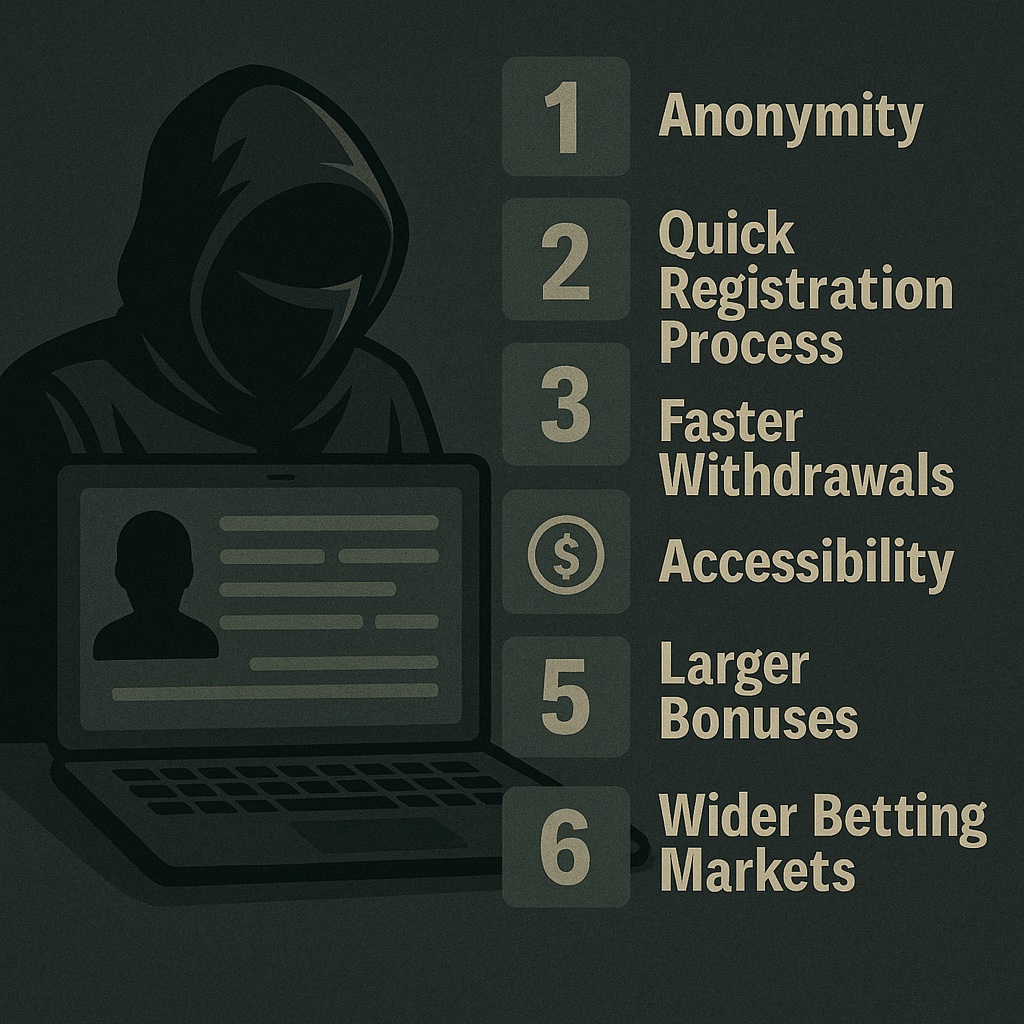
No-KYC betting sites promote a list of advantages, from privacy to faster withdrawals and wider access. Here is how each claim holds up for US players, and how to get the legitimate part of each benefit at a licensed sportsbook:
1. Anonymity
Anonymity is the main selling point of no-KYC sites, and for US players it is the main problem. Licensed sportsbooks cannot offer anonymous accounts, because state rules require verified identity and age.
Anonymity also cuts both ways. Without a verified identity, you have no way to prove an account is yours if it is locked, and no regulator to turn to. And crypto is not as private as it looks: public blockchains record every transfer. Federal law also targets payments to unlawful internet gambling under UIGEA, which is why banks may block transfers to these sites.
2. No SSN or Photo ID Needed
Many people worry about sharing an SSN or a photo ID, and data breaches are a real risk. But state rules set what is collected, and some allow less than the full number: Kentucky’s rule accepts either the full SSN or its last four digits. A photo ID is often needed only if the automatic check fails. Licensed operators must protect that data under their state licence, which an unlicensed site does not.
3. Quick Registration Process
Speed is a fair concern, and licensed sportsbooks have made sign-up fast. In most cases you enter your details, the automatic check runs, and you are verified during sign-up without uploading anything.
If you are asked for a document, a clear photo of a valid driver’s license or passport is usually enough. Regulated prediction market Kalshi, for example, says document verification usually takes just a few minutes when the photo is clear. Preparing your ID in advance is the simplest way to keep registration quick.
4. Faster Withdrawals
Fast withdrawals are a reasonable thing to want. At licensed sportsbooks, the biggest delays usually come from incomplete verification, so finishing KYC at sign-up is the best way to speed up your first payout.
Withdrawal times depend on the method and the operator, and each sportsbook lists its own processing times. Crypto payouts from offshore sites may look fast, but speed means little if a site can refuse to pay and there is no regulator to make it.
5. Accessibility
Sports betting in the US is licensed state by state, and a majority of states have now legalized it. If you live in or visit one of those states, you can bet with a licensed sportsbook while you are physically there.
Placing a wager through a no-KYC site or while connected to a VPN from a state where sports betting has not been legalized still counts as unauthorized betting. In states that have yet to legalize sports betting, the choices that are permitted remain narrow and vary by product: daily fantasy sports are allowed in certain states, sweepstakes platforms can operate only in states that have not banned them, and whether sports event contracts offered at prediction markets are lawful remains contested in some states.
6. Larger Bonuses
Offshore sportsbooks often advertise bigger bonuses than licensed ones. The headline size hides the terms: high playthrough, short expiry and rules you cannot enforce if the site decides not to pay.
Licensed sportsbooks publish full bonus terms subject to state rules, and your bonus is tied to a verified account. Compare offers by their terms, not their headline numbers.
7. Wider Betting Markets
Offshore sites may list markets that state regulators do not allow, such as some college player props or political events. Those limits exist for integrity reasons, and betting on them at an unlicensed site does not make the bet lawful.
At licensed sportsbooks, the market list is set by the events and bet types each state has approved. Some political and economic events are traded as event contracts at CFTC-regulated exchanges, a separate product with its own rules and its own state disputes.
Potential Drawbacks and Risks to Anonymous Betting
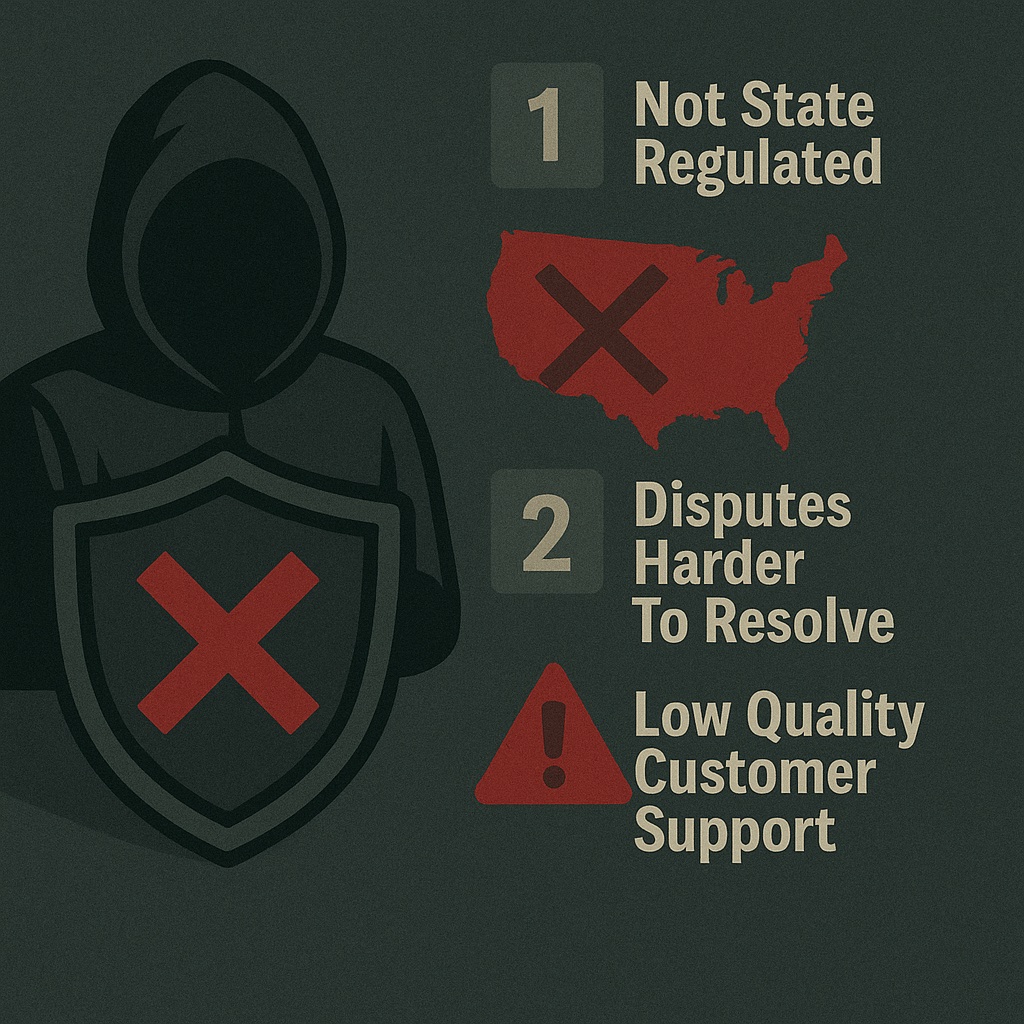
Anonymous betting trades state protections for convenience. These are the main points for US players to weigh:
Not State Regulated
No-KYC sportsbooks are not licensed by any US state regulator. That means no state testing of the platform, no enforced responsible gambling tools and no oversight of how bets are settled. State regulators act against these sites: the Michigan Gaming Control Board has sent cease-and-desist orders to offshore operators targeting Michigan residents, and urges players to use only state-licensed platforms. Read more about the risks of offshore sportsbooks.
Disputes Harder To Resolve
If a licensed sportsbook refuses a withdrawal or settles a bet wrongly, you can complain to the state regulator. At a no-KYC site there is no US regulator, and crypto transfers are hard to reverse. The anonymity the site offers also works against you: without a verified identity, proving that an account and its balance are yours is difficult.
Low Quality Customer Support
Unlicensed sites have no regulator setting standards for support or complaint handling. Even where support exists, it has limited ability to help an anonymous account, and nothing obliges the site to follow its own published terms. At a licensed sportsbook, support is backed by a formal complaint route to the state.
Anonymous Sportsbooks Vs. Traditional KYC Sportsbooks
| No-KYC Sportsbooks | KYC Sportsbooks |
| ❌ Not licensed in any US state. | ✅ Licensed by the state regulator or lottery where they operate. |
| ❌ No age check, so no barrier to underage betting. | ✅ Identity and age verified before the first bet. |
| ❌ May still demand documents before paying a withdrawal. | ✅ Verification done once at sign-up, so withdrawals are not held up for it later. |
| ❌ Rarely offer official iOS or Android apps. | ✅ Apps for the states where they are licensed. |
| ❌ Anonymous accounts are hard to recover. | ✅ Accounts tied to your verified identity. |
| ❌ Crypto payouts are hard to reverse if something goes wrong. | ✅ Payouts to methods in your name, under state rules. |
| ❌ No enforced responsible gambling tools. | ✅ Deposit, wager and time limits and self-exclusion. |
| ❌ Markets not approved by any state regulator. | ✅ Markets approved by the state regulator. |
| ❌ Bets from states without legal sports betting are not authorized. | ⚠️ Only available in states where the specific sportsbook holds a licence. |
| ❌ Location masking with VPNs encouraged, breaching state location rules. | ✅ Location checked before every session. |
| ❌ Bonus terms often high and hard to enforce. | ✅ Bonus terms published and subject to state rules. |
| ❌ Very little recourse if there’s a dispute with the sportsbook. | ✅ US-based sportsbooks fall under the jurisdiction of the state’s gambling authority, which handles complaints. |
| ⚠️ Deposits mostly in cryptocurrencies; few fiat options. | ⚠️ Payment methods approved under the state licence; check the cashier for what is offered. |
| ❌ Operate outside US licensing; regulators issue cease-and-desist orders against such sites. | ✅ Fully licensed and legal within their specific state(s); clear regulatory protections apply. |
| ❌ Casino and sportsbook often combined in one unlicensed wallet. | ⚠️ Sports and casino may be separate products, and online casino is legal in only seven states. |
| ❌ Reputation and trustworthiness vary widely, with no regulator checking. | ✅ Listed by name on the state regulator’s approved operator list. |
| ❌ Winnings still taxable, with no records to support your return. | ✅ Account history and Form W-2G where thresholds are met. |
Popular Sports You Can Bet on at No ID Betting Sites
At state-licensed sportsbooks, the sports and markets on offer are those your state regulator has approved, and they cover far more than most bettors need. Below is a summary of the most common sports categories you’ll find, with the caveat that exact markets vary by state:
- 🏈 Football (NFL): The NFL is the biggest betting market in the US, with moneylines, spreads, over/unders and player props, plus live betting during games. College football is widely offered, though some states limit bets on in-state college teams or on college player props.
- 🏀 Basketball (NBA & International): The NBA’s fast pace and frequent scoring make it a favorite for prop-heavy bettors. Many books also offer action on EuroLeague, NCAA and FIBA competitions, subject to state approval.
- ⚾️ Baseball (MLB): With 162 games per team, MLB provides daily betting opportunities. Expect markets like run lines, total bases, pitcher strikeout props and first five innings bets.
- 🏒 Hockey (NHL & International): NHL betting includes moneylines, puck lines, goal totals and player props. Many books also cover international events like the IIHF World Championship and Olympic hockey.
- ⚽️ Soccer (MLS & Global): Soccer fans can wager on MLS, the Premier League, La Liga, Serie A, Bundesliga, Ligue 1, the Champions League, the Europa League and the World Cup. Expect 90-minute markets, both teams to score (BTTS), Asian handicaps and corner props.
- 🎾 Tennis: Bet on ATP, WTA, Grand Slam, Challenger and ITF events. Popular markets include match winner, over/under games, exact set score and live betting by set.
- 🤜 MMA (UFC): Licensed books offer pre-fight and in-fight betting on major cards. Look for moneylines, method of victory, round betting and fight to go the distance props.
- 🥊 Boxing: Includes major cards and undercards. Available markets include winner, total rounds, KO/TKO method and decision outcome.
- 🎮 Esports: Esports markets such as Counter-Strike, League of Legends, Dota 2 and Valorant are available only for the events your state regulator has approved, so coverage varies by state.
- ⛳️ Golf: Includes the PGA Tour and major championships. Bet on tournament winner, top 5/10/20 finishes, head-to-heads and round-by-round props.
- 🏎️ Motorsports (F1 & NASCAR): Available markets include race winner, podium finishes, head-to-head driver matchups and fastest lap bets.
- 🏓 Table Tennis: A niche market at some books, depending on the leagues the state has approved. Bet on match winner, total points and correct score.
- 🏏 Cricket: Markets may be available for the IPL, international tournaments and more, depending on the book and state. Common bets include match winner, top batsman, run totals and player props.
- 🎯 Darts & Snooker: Events like the PDC World Championship can feature, with odds on match results, 180s thrown and highest checkout, where the state allows them.
- 🏉 Rugby (Union & League): Markets on competitions such as the Six Nations, Rugby World Cup and NRL may be offered, including handicaps, try scorers and winning margins.
Whether you follow major US leagues or niche global competitions, a licensed sportsbook covers a broad range of sports, with the advantage that every market has been approved by your state regulator. Check your sportsbook’s house rules for how each market is settled.
Types of Bets at No ID Betting Sites
The bet types offered by no-ID sites are the same ones you’ll find at licensed sportsbooks. The difference is that at a licensed book, the rules for each bet type are published in house rules that the state regulator oversees.
The most common bet types available include:
- Moneyline: A straightforward bet on which team or player will win.
- Point Spread/Handicap: Wagering on whether a team will win by a certain margin (or avoid losing by too much).
- Over/Under (Totals): Betting on whether the total combined score will be above or below a set line.
- Parlays: Combining multiple bets into one ticket for a bigger payout, including same-game parlays (SGPs) at many licensed books.
- Live/In-Play Bets: Betting on games that are already in progress, with odds that shift in real time.
- Props (Proposition Bets): Wagers on specific events within a game, like player stats, first scorer or total rebounds. Some states restrict college player props.
- Futures: Long-term bets on outcomes like league champions, MVP winners or tournament results.
- Round/Period Betting: Especially popular in MMA, boxing and hockey; bets on individual rounds or periods.
- Correct Score & Exact Result: Higher-risk wagers that predict the exact final score or outcome.
- Asian Handicap & Double Chance: More common in soccer and international sports; designed to balance the odds in lopsided matchups.
Want to bet with strategy? Many licensed sportsbooks also offer cash-out, bet builders and odds boosts. Use them within a budget, and set deposit and wager limits in your account before you start.
How To Start Betting at a No SSN Sportsbooks
There is no licensed US sportsbook that lets you skip identity checks, but the process is usually quick. Depending on the state and operator you may be asked for your full SSN or only its last four digits, and automatic checks usually finish during sign-up.
Here’s how to get started at a licensed sportsbook:
- Choose a licensed sportsbook: Check that the operator is on your state regulator’s or lottery’s approved list and that you meet the minimum age, 21 in most states.
- Register an account: Enter your legal name, date of birth, home address and the SSN digits requested. Use the details exactly as they appear on your ID.
- Verify: Most accounts are verified automatically. If asked, upload a clear photo of a valid driver’s license or passport, and a selfie if requested.
- Confirm your location: Switch off any VPN and allow location access, so the sportsbook can confirm you are in the state.
- Deposit and set limits: Fund your account with a payment method in your name, and set deposit and time limits before you bet. Then withdraw to a method in your name when you want to cash out.
One verification at sign-up is the trade-off for a regulated account: your bets, balance and withdrawals are protected by state rules.
Best Payment Methods for No KYC Betting
No payment method removes the identity check at a licensed sportsbook, and no regulated product offers crypto without KYC. Below are the methods most often discussed for no-KYC betting, and what each means for US players:
Bitcoin (BTC) & Ethereum (ETH) – Most Widely Accepted
Bitcoin and Ethereum are the most widely accepted cryptocurrencies at offshore sites. For US players, the regulated or permitted places to use crypto are products that document it, such as CFTC-regulated prediction markets with published crypto deposit procedures and sweepstakes platforms whose terms allow crypto purchases, in the states where they are available.
Both networks have downsides: Bitcoin confirmations can take time when the network is busy, and Ethereum fees rise when the network is congested. Crypto deposits are typically converted to dollars at regulated products, so network and conversion fees apply.
TRON (TRX) – Fast & Cheap
TRON is a blockchain known for low fees and fast transfers, and it is widely used for stablecoin payments. It is mainly accepted at offshore sites. If a regulated or permitted product supports it, use only the network the product names: sending a token on an unsupported network can mean losing the funds.
Solana (SOL) – Low Fees
Solana is a fast blockchain with low transaction fees, and it is common at offshore crypto sites. Support at regulated or permitted products varies, so check the product’s own help or banking page for the assets and networks it accepts, and note that verification still applies before you can deposit or withdraw.
Visa & Mastercard (Fiat)
Some no-KYC sites accept cards through third-party processors that sell you crypto. Those processors usually run their own identity checks, so the “no-KYC” promise does not hold. At licensed sportsbooks, debit cards in your own name are a common deposit method, though some banks decline gambling transactions.
Online Bank Transfer (Fiat)
Bank transfers always involve an account in your name. At licensed sportsbooks, online banking is a common way to deposit and withdraw, and it helps match your payment method to your verified account.
If you want the smoothest experience, complete verification at sign-up and use payment methods in your own name. That is what keeps withdrawals quick, not the choice of coin.
Bonuses at No Verification Betting Sites

Bonuses at no-verification sites are often large on paper, but they come from operators you cannot hold to their terms. At licensed sportsbooks, bonuses are paid only to verified accounts and must follow state rules. Here is what the main bonus types mean:
Welcome Bonus
Licensed sportsbooks offer welcome bonuses to new verified customers, often as bonus bets or a refund in bonus bets. Read the terms for the qualifying bet, the expiry date of any bonus bets and the states where the offer applies. An offer is only valid in states where the sportsbook is licensed.
Deposit Match Bonuses
Deposit matches give a percentage of your deposit as bonus funds, usually with a playthrough requirement before you can withdraw. Check the cap, the playthrough multiple and the expiry, and remember that the bonus is never a reason to deposit more than you planned.
Free Bets
Free bets, often called bonus bets, are wager credits with a set value. Winnings usually exclude the stake, and bonus bets often expire if unused. Check the minimum odds and the markets they can be used on.
Odds Boosts
Odds boosts raise the price on a selected market for a limited time, usually with a maximum stake. They can add value, but check the original odds and the boost cap to see what you actually gain.
VIP Programs
Loyalty programs at licensed sportsbooks reward verified accounts with points or perks. Treat them with care: rewards that encourage more betting can work against your budget, and you should be able to use limits and self-exclusion at any time.
How Wagering Requirements Work
Wagering requirements, also known as playthrough requirements, determine how many times you need to bet your bonus (and sometimes your deposit) before you can withdraw any winnings. Bonuses aren’t “free money”: they come with conditions, and understanding the fine print is essential.
For example, if you claim a $100 bonus with a 5x playthrough requirement, you’ll need to wager $500 before the bonus becomes eligible for withdrawal. Some offers apply the playthrough to the bonus amount only, while others apply it to both the bonus and the deposit, known as a combined rollover. This distinction makes a big difference in how much you actually need to wager.
Time limits are also common, and failing to meet the requirement in time will forfeit your bonus and any associated winnings. Certain bet types may be excluded or limited (like hedge bets or very short odds), and not all wagers count equally. Some sportsbooks reduce contribution rates for certain markets or sports.
Always read the bonus terms before claiming an offer. If you’re not prepared to meet the wagering conditions, it’s often smarter to skip the bonus and keep your balance fully withdrawable from the start.
Tips for No KYC Betting – 10 More Things to Know
If you came here looking for no-KYC betting, these are the ten things worth knowing before you open any account. They will help you bet legally, protect your money and keep your data safe.
1. Check the Regulator’s List First
You won’t find any no-KYC betting sites licensed by US state regulators, and offshore licences from places such as Curaçao or Anjouan do not authorize bets from US states. Use only sportsbooks on your state regulator’s or lottery’s approved list, and check prediction markets on the CFTC’s prediction markets page, which explains how to check a firm’s registration.
2. Switch Off Your VPN Before You Bet
Licensed sportsbooks must confirm you are in a state where they are licensed before they accept a bet. Using a VPN to hide your location breaches their terms and the state’s location rules, and can get your account closed and winnings voided. Use a VPN for general privacy if you like, but switch it off before you bet.
3. Keep Crypto Wallet Secure
If you hold crypto for any regulated or permitted product, keep your wallet secure. Store recovery phrases offline, use two-factor authentication on exchange accounts and never share your seed phrase with anyone who contacts you claiming to be support.
4. Watch for Crypto Network Fees
Crypto deposits involve network fees, and regulated products may add conversion or provider fees when they convert crypto to dollars. Check the fees before you send funds, and make sure you use a supported asset on a supported network.
5. Check for Provably Fair Games at the Casino
“Provably fair” games let players check outcomes using cryptography, but the site certifies itself. It is not a substitute for testing by a state regulator. New Jersey’s Division of Gaming Enforcement, for example, tests internet gaming platform systems before they are used. Real-money online casino games are licensed only in New Jersey, Pennsylvania, Michigan, West Virginia, Connecticut, Delaware and Rhode Island, for players aged 21 and over.
6. Account Recovery Can Be Risky
With no KYC, there’s no ID-based account recovery. If you lose your password or wallet keys at an anonymous site, you may lose your balance. A verified account at a licensed sportsbook can be recovered by proving who you are. Use a password manager either way.
7. Paying Taxes on Winnings
Gambling winnings are taxable income in the US. According to IRS Topic 419, you must report all gambling winnings, whether or not you receive a Form W-2G, and you can deduct losses only if you itemize, and only up to the amount of winnings you report. Keep records of your wins and losses. Consult a tax professional if you’re unsure how to report.
8. Bonus Abuse Can Get You Banned
Creating multiple accounts, using VPNs to claim offers from other states, or abusing promo terms can get your account closed and bonuses voided, at licensed and unlicensed sites alike. One account per person, in your own name, is the rule.
9. Read Reviews & Conduct Research
Research any sportsbook before depositing, starting with the regulator’s list. Check your state regulator’s warnings and enforcement notices, and read the operator’s terms in full. User reviews can help with support and payout experience, but a licence check comes first.
10. Stick To Recognized Cryptos
If you use crypto with a regulated or permitted product, stick to the assets and networks it lists. Established coins like BTC, ETH or USDC are the most commonly supported. Exotic tokens and memecoins can swing sharply in value and are rarely accepted by regulated products.
Responsible Gambling
Responsible gambling depends on tools that anonymous sites cannot enforce. Self-exclusion and deposit limits only work when an account is tied to a verified person, which is one of the reasons licensed sportsbooks verify ID. Set limits before you start, take breaks and never chase losses.
The National Problem Gambling Helpline is free, confidential and available 24/7: call or text 1-800-MY-RESET (1-800-697-3738), or chat online. These resources can also help:
- National Council on Problem Gambling (National Problem Gambling Helpline, 1-800-MY-RESET)
- 1-800-GAMBLER (Council on Compulsive Gambling of New Jersey, an additional 24/7 line)
- Gamblers Anonymous
Want to Bet Anonymously? What No-KYC Betting Means for US Players
No-KYC sportsbooks promise privacy and speed, but for US players they mean betting with a site that is not licensed in any state, with no state regulator and no state-enforced player protections. Every licensed US sportsbook verifies identity and age, because state rules require it.
The good news is that verification at licensed sportsbooks is usually quick, often finished during sign-up, and beyond your personal details and SSN digits you usually need a photo ID only if the automatic check fails. If you want crypto, use only regulated or permitted products that document it, such as CFTC-regulated prediction markets, in the states where they are available.
Key Takeaways:
- No licensed no-KYC books: every US-licensed sportsbook verifies identity and age.
- What you’ll need: legal name, date of birth, home address and SSN digits; a driver’s license or passport if the automatic check fails.
- How long: automatic checks usually finish during sign-up; document reviews take longer.
- Minimum age: 21 in most states.
- Location: you must be in a state where the sportsbook is licensed; no VPNs.
- Crypto: only where a regulated or permitted product documents it, with KYC.
- Prediction markets: CFTC-regulated, but sports event contracts are disputed in some states.
- Sweepstakes: banned or restricted in CA, NY, NJ, CT, MT, IN, ME, TN, OK and LA.
- Taxes: gambling winnings are taxable income.
- Offshore sites: not licensed in any US state, so state complaint routes do not apply.
- Help: call or text 1-800-MY-RESET, 24/7.
References
- 809 KAR 10:004, Kentucky sports wagering account requirements, Kentucky Legislative Research Commission
- N.J.A.C. 13:69O-1.2, General requirements for Internet and mobile gaming, Legal Information Institute, Cornell Law School
- New Jersey Division of Gaming Enforcement
- Pennsylvania Gaming Control Board, PA Licensed Online Gaming Operators
- Connecticut Department of Consumer Protection, Legal Gaming in Connecticut
- Connecticut Department of Consumer Protection, cease-and-desist release, December 3, 2025
- Michigan Gaming Control Board, release on unlicensed offshore gambling websites
- CFTC, designation of KalshiEX LLC as a contract market, November 4, 2020
- Commodity Futures Trading Commission, Prediction Markets
- Kalshi Help Center: Crypto Deposits; What information is required to verify my Kalshi account; Document verification on Kalshi
- Sweepstakes platform terms and conditions, as published by each platform
- 31 U.S.C. 5363 (Unlawful Internet Gambling Enforcement Act), Legal Information Institute, Cornell Law School
- IRS Topic 419, Gambling income and losses
- National Council on Problem Gambling, Help and Treatment
No KYC Betting Sites FAQs
1. Are No KYC sportsbooks safe to use, or are they all scams?
Sportsbooks that skip ID checks are not licensed in any US state, so there is no state testing, no enforced player protection and no regulator to complain to. Licensed US sportsbooks verify your identity at sign-up, which is what lets a state regulator step in if a withdrawal is not paid.
2. Why do some betting sites skip the ID verification process?
Sites skip verification because they operate outside US licensing. Licensed sportsbooks must verify identity and age before you bet, to keep minors out, prevent fraud and money laundering, and make self-exclusion and tax reporting work.
3. Can I withdraw my winnings anonymously from a No KYC site?
Not at a licensed sportsbook: withdrawals go to payment methods in your own name after verification. Offshore no-KYC sites often reserve the right to demand documents before paying, and crypto payouts are hard to recover if a site refuses to pay.
4. What cryptocurrencies can I use on No KYC betting platforms?
No regulated US product offers crypto betting without KYC. Crypto is accepted only where a regulated or permitted product documents it, such as CFTC-regulated prediction markets with published crypto deposit procedures, or sweepstakes platforms whose terms allow crypto purchases, and identity checks still apply.
5. Do No KYC betting sites have limits on deposits or withdrawals?
Offshore sites set their own limits, which no US regulator enforces. Licensed sportsbooks publish their limits and must let you set your own deposit, wager and time limits, as well as self-exclude.
6. Can I access No KYC sportsbooks from the US legally?
No. Sportsbooks that skip identity checks are not licensed in any US state, and using a VPN to reach them breaches their terms and state location rules. Bet only with a sportsbook licensed in your state, where the minimum age is 21 in almost every state.
7. What happens if I lose access to my No KYC betting account?
Without a verified identity, there is usually no way to prove the account is yours, so you may lose the balance. A verified account at a licensed sportsbook can be recovered by confirming your identity with the operator.
8. How long does ID verification take at a licensed sportsbook?
Usually only minutes: most sportsbooks check your name, date of birth, address and SSN digits automatically during sign-up. If that check fails you upload a driver's license or passport, and a manual review takes longer. Kalshi, for example, says document checks usually take a few minutes with a clear photo.

Marta Cutajar is an experienced iGaming and sports betting writer with over 7 years of experience in the online gambling industry. She has written extensively for major online casinos and sports betting sites, covering betting guides, casino reviews, and regulatory updates.