
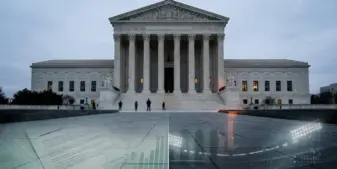
New Jersey Attorney General Jennifer Davenport has filed a petition asking the U.S. Supreme Court to decide whether prediction markets can offer sports wagers without following state gambling laws, following a divided Third Circuit ruling in April 2026 that held New Jersey’s gambling statutes preempted as applied to Kalshi. The 2-1 decision sided with Kalshi’s argument that its sports contracts are federally regulated swaps, not state-regulated wagers. Litigation over the question has spread to at least 20 states, with dozens of active suits pending and several states’ gambling laws currently enjoined by federal courts.
At the center of the dispute is Kalshi’s self-certification of sports markets with the Commodity Futures Trading Commission, which the company says gives it exclusive federal cover to operate nationwide. New Jersey counters that Kalshi must comply with state rules covering compulsive gambling, underage wagering, insider trading on sporting events, and operator financial stability. Kalshi sued New Jersey in 2025 over the state’s attempt to enforce those laws, and the company has marketed itself as offering legal sports betting in all 50 states – a characterization New Jersey disputes, particularly regarding wagers on NCAA games involving New Jersey teams. The Nevada licensing dispute raises a parallel version of the same question.

Circuits Split, Petition Follows
The Third Circuit’s April 2026 ruling found New Jersey’s gambling laws preempted, but the Ninth Circuit explicitly disagreed on August 28, holding that sports bets tied to game outcomes fall outside the CFTC’s exclusive jurisdiction. Davenport’s petition – the first certiorari filing on this business model, according to the source evidence – asks the Supreme Court to resolve the conflict directly. No fine, settlement or final ruling has been reported; the case remains a pending request for review, tracked alongside New Jersey’s parallel challenge over the swaps classification.
Dodd-Frank at the Core
The legal question turns on whether Congress, through the 2010 Dodd-Frank Act, silently federalized sports wagering by classifying Kalshi’s contracts as swaps. New Jersey argues the CFTC has admitted it is not a gaming regulator and lacks specialized oversight expertise, and points to Murphy v. NCAA, where the Supreme Court held that absent direct congressional regulation, each state remains free to set its own sports-gambling policy. New Jersey’s Constitution restricts gaming to voter-approved exceptions, a limit the state says Kalshi ignores entirely.
Forty-four states, hundreds of Tribes and casino operators have opposed Kalshi’s litigation position, and New Jersey co-led an amicus brief joined by 39 jurisdictions in the Ninth Circuit matter. State sports betting generated $16.89 billion in 2025 revenue excluding tribal sportsbooks, while 95% of Kalshi’s 2025 revenue came from sports betting, according to the petition. New Jersey warns a Kalshi win could unravel protections at brick-and-mortar casinos in Atlantic City, Las Vegas and on tribal land – a consequence explored further in coverage of prediction-market regulation in Oklahoma.
Interim Division of Gaming Enforcement Director Mary Jo Flaherty has framed the case as a states’ rights matter, arguing New Jersey is simply upholding voter-approved constitutional limits on gaming. The petition is led by Solicitor General Jeremy Feigenbaum, Deputy Solicitor General Stephen Ehrlich and Special Assistant Liza Fleming, with support from Deputy Attorneys General Emily Bisnauth, Patrick Jhoo and Vivek Mehta.
Source: Shore Local News

When he is not analysing the latest compliance updates or dissecting quarterly operator results, Florian follows Bundesliga football closely and maintains a healthy skepticism toward anyone claiming to have cracked a winning betting system. He brings a grounded, insider-aware perspective to his writing and is always more interested in the structural story behind the headline than the headline itself.