
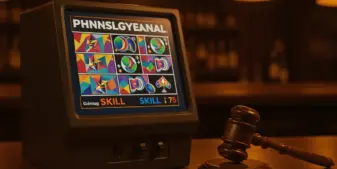
The Pennsylvania Supreme Court has ruled that skill games constitute slot machines under the commonwealth’s gambling and crime statutes, overturning a series of Commonwealth Court decisions that had shielded the devices from casino-style regulation and exposing an estimated 70,000 machines operating statewide to potential law enforcement seizure. The majority found that skill games satisfy the statutory definition of a slot machine “several times over,” rendering the skill element legally immaterial to their classification. The ruling resolved two consolidated cases simultaneously, including a 2019 property seizure dispute originating in Dauphin County and a separate legal challenge brought by Pace-O-Matic, the leading skill games developer and distributor in the state.
The procedural path to Monday’s decision stretched back to a 2019 seizure in which Dauphin County authorities confiscated Pennsylvania Skill machines from a Hershey-area business, triggering litigation over whether the devices fell within the Crimes Code’s definition of a slot machine. Both the Dauphin County Court of Common Pleas and Commonwealth Court ruled in favour of the operators, finding the games were predominantly skill-based and therefore outside the regulatory perimeter applicable to slot machines. Commonwealth Court reinforced that position in a unanimous December 2023 decision authored by Judge Lori Dumas, holding that the machines were “not slot machines as commonly defined.” Pace-O-Matic’s parallel declaratory action produced a similar outcome at the Commonwealth Court level, with the lower court holding that the Gaming Act did not reach skill games at all.
The Supreme Court majority rejected both conclusions as “deeply flawed,” finding Commonwealth Court “incorrect on both points.” Applying the statutory text, the majority held that a skill game meets the ordinary English definition of “a coin-operated gambling machine that pays off according to the matching of symbols on wheels spun by a handle,” and that the Gaming Act’s language plainly extends beyond licensed casino facilities to cover unlicensed devices of this type. The court declined to address broader policy questions, noting that its decision “does not constitute an endorsement of, any particular policy view concerning the proliferation of ‘skill games’ throughout our Commonwealth,” and that the General Assembly “remains free at any time to take whatever legislative action it may deem appropriate.” No details on the vote margin have been reported at the time of publication.
The immediate operational consequence is a 120-day moratorium during which law enforcement cannot move against the machines – a window designed to give the legislature room to construct a regulatory framework before seizures commence. Should the General Assembly fail to act, state police and local prosecutors will hold a clear mandate to begin large-scale confiscations across the taverns, gas stations, veterans’ clubs, and convenience stores where the devices have proliferated. The Independent Fiscal Office has estimated that a regulated skill games market could generate more than $1 billion annually in tax revenue, a figure that carries considerable weight as Harrisburg navigates a contested budget cycle. The scale of the market and the complexity of enforcement against 70,000 dispersed machines make a legislative resolution the path of least resistance, though the terms of that resolution remain deeply contested – a dynamic familiar to regulators and operators tracking the broader push to formalise US gambling oversight at both federal and state levels.
Pace-O-Matic said in a statement it is “disappointed with the decision” and strongly believes the ruling “does not accurately reflect the facts presented,” warning that small businesses and fraternal clubs now face an impossible choice between shutting down the machines and absorbing a legislative outcome that could impose “excessive regulation and crippling taxation.” That framing reflects the fault line that has paralysed skill games legislation in Pennsylvania for years: casinos have pressed for a high tax rate to level competitive conditions, while the skills industry argues that anything approaching the existing 55% rate on electronic games and casino slots would effectively eliminate their market. Governor Josh Shapiro’s proposed budget sets a 52% rate for skill games; State Senate Republicans have backed 35%; and a faction of Republicans has proposed as low as 16%. The gap between those positions has prevented a deal from closing across multiple legislative sessions, even as the unregulated machine count climbed from roughly 40,000 to the current estimate. The situation carries echoes of enforcement actions seen elsewhere when gaming machines operate outside legal frameworks, as demonstrated by the UKGC’s enforcement raids against unlicensed gaming operations.
State Senate Republican leaders called skill games regulation a “critical piece of resolving this year’s budget,” characterising the issue as “a matter of public safety which must be addressed,” while State House Democrats said they are still reviewing the decision. State Representative Ben Waxman (D., Philadelphia) urged caution, telling Spotlight PA: “What we are talking about here is the potential largest expansion of gambling in Pennsylvania history since the casinos. And we cannot make short-term decisions with really long-term consequences.” The 120-day clock now running means lawmakers must reach consensus on tax rates, licensing structures, location restrictions, and consumer protections within a tight window – or hand enforcement discretion to law enforcement agencies that have shown varying degrees of appetite for acting against politically embedded small-business operators. Industry observers will also be watching whether the ruling carries persuasive authority in Virginia, Illinois, and other states where analogous skill game disputes remain unresolved, given that the recent trend of tightening state-level gambling law suggests Pennsylvania’s outcome may accelerate similar statutory reclassifications elsewhere.

Renata Kovacs has spent the better part of a decade following the regulatory shifts and licensing battles that define how gambling markets open, close, and evolve across Europe and beyond. She came up through the legal and compliance side of the industry before shifting her focus to journalism and analysis, giving her a perspective that sits closer to the operator room than the press box. Her coverage tends to cut through the noise and get straight to what a regulatory change actually means for the businesses and players involved.